

The contemporary logic for purchasing an SUV often rests on a series of hypotheticals: the occasional large haul, the infrequent dirt road, the perceived need for a commanding view. These abstractions dissolve when faced with a concrete task, like loading gear for a weekend of mountain biking and camping. Open the standard power liftgate of the Audi A6 Allroad, and you are greeted not with a high load floor that requires heaving, but with a low-lipped, rectangular void offering 30.5 cubic feet of space, a shape as honest and functional as a well-designed toolbox. Two adult mountain bikes, wheels on, slide in parallel with room to spare along the sides for duffel bags and a cooler, a feat that would demand a roof rack or a hitch carrier on many midsize SUVs compromised by intrusive wheel arches or sloped rear ends.
This utility is not born from bulk but from intelligent architecture. The Allroad's wagon profile provides a ceiling that follows the roofline deep into the cargo area, creating a near-perfect cuboid for stacking gear where an SUV's coupe-like styling often pinches space at the rear. The 40/20/40 split-folding rear seats disappear flush with the load floor at the tug of a lever, expanding capacity to 59.3 cubic feet, a continuous plane longer than many full-size sedans. For loading skis or lumber, a pass-through hatch built into the center armrest allows objects to extend into the cabin, a simple mechanical solution that feels ingeniously pragmatic.
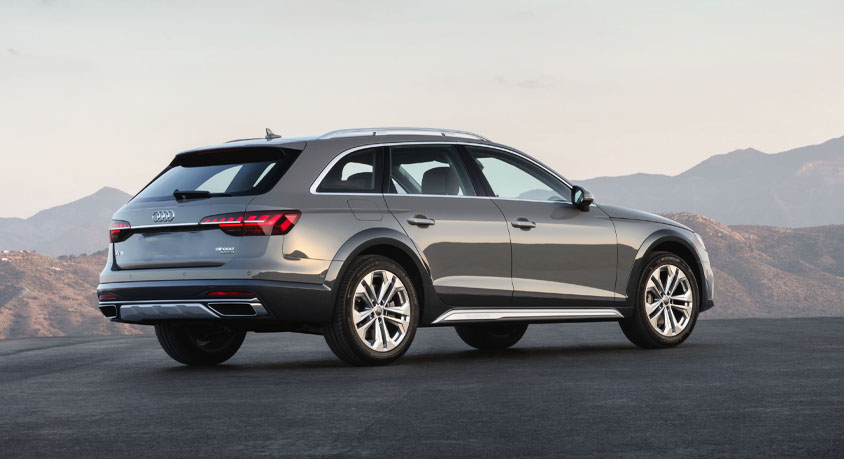
The vehicle's true genius, however, lies in its dynamic contradiction. At the press of a button, the standard adaptive air suspension can raise the body by 1.6 inches for light trail duty or steep driveway approaches, providing a maximum ground clearance that rivals a conventional crossover. Yet on pavement, it lowers itself, firming up dampers to deliver the poised, connected driving feel of an A6 sedan—a low center of gravity and precise steering that an SUV’s taller, heavier body simply cannot replicate. It tackles a gravel forest service road with the relaxed assurance of a raised vehicle, then devours the winding asphalt return route with the grace of a grand tourer, its suspension acting like a skilled translator between two different languages of terrain.
Power from the 3.0-liter turbocharged V6 is delivered with a smooth, linear urgency through a quick-shifting transmission, propelling the Allroad with an elegance absent in the gruffer, more turbulent power delivery of many turbo-four SUVs. The cabin, insulated and crafted with Audi’s typical precision, remains a library of calm where an SUV might broadcast road roar and wind rush, allowing the driver to converse at a normal volume or appreciate the subtle details of an orchestral piece on a long drive to a remote trailhead. This duality questions the very premise of the compromised, jack-of-all-trades SUV, proposing instead a vehicle that masters two worlds without apology.
Ultimately, the A6 Allroad presents a compelling case not through negation, but through a more elegant synthesis of form and function. It argues that the essence of utility is not a high seating position, but accessible, rational space; that all-terrain capability need not come at the expense of on-road refinement. It serves as a physical manifesto for a different kind of lifestyle vehicle—one defined not by rugged pretense, but by intelligent readiness. The cargo hold is merely the most visible proof of this philosophy, a single, capacious answer to a hundred scattered doubts about the wagon’s relevance in an age of ubiquitous high-riders.
Disclaimer: Mention of any brand or trademark is for identification purposes only and does not indicate any partnership or endorsement.
