

The steering wheel trembles with a faint, organic vibration as the tachometer needle swings toward redline, not from imbalance but from the road surface itself transmitting a language of texture directly to your palms. In an era where every new vehicle seems designed to isolate you from the act of driving, where lane-keeping systems tug at the wheel and adaptive cruise control renders the driver a mere passenger, the 2026 Mazda CX-5 arrives as a philosophical counterargument. It's larger than before, finally spacious enough for six-foot adults in the back seat, and its infotainment system has traded the beloved rotary controller for a massive touchscreen. Yet beneath the sheet metal changes and digital upgrades, the CX-5 remains stubbornly committed to a proposition that most of the industry has abandoned: that driving should feel like something. We spent a week with the redesigned model, carving through the kind of winding back roads that make California's Encinitas a driver's paradise, to understand why Americans keep buying this "old-school" SUV in record numbers even as Mazda tries to sell them something newer.
Let's start with the paradox of Mazda's own product lineup, because it reveals something fundamental about American buyer psychology. When the CX-50 arrived in 2023, positioned as larger, more rugged, and built in Alabama alongside the Toyota Corolla Cross, industry observers assumed it would gradually replace the aging CX-5. Instead, the Hiroshima-built CX-5 continued outselling its newer sibling, proving that customers recognized something the marketing materials couldn't articulate. For 2026, the CX-5 has grown to within an inch of the CX-50's dimensions, sharing the same 110.8-inch wheelbase and offering comparable passenger space. Yet the two remain fundamentally different in character: the CX-50 leans into outdoor adventure with its turbo engine option and rugged styling, while the CX-5 doubles down on urban sophistication and driving purity. Mazda's president describes the CX-5 as "slightly more urban," and that distinction matters to buyers who prioritize feel over fashion.
The engine bay contains the most controversial decision in the CX-5's history. For 2026, Mazda has dropped the optional 256-horsepower turbocharged four-cylinder entirely, leaving only the naturally aspirated 2.5-liter producing 187 horsepower and 186 pound-feet of torque. On paper, this looks like regression. The 0-60 mph sprint now requires approximately 8.2 seconds, sluggish by modern standards, and merging onto high-speed freeways demands planning and commitment. Yet the driving experience transcends the spec sheet. The six-speed automatic transmission, ancient by industry standards, remains a masterpiece of calibration, downshifting instantly when you prod the throttle and holding gears through corners with an enthusiasm that CVTs and dual-clutch units can't match. The engine builds power linearly, predictably, communicating its intentions through the accelerator pedal rather than hiding behind turbo lag. It's the difference between a conversation and a lecture.
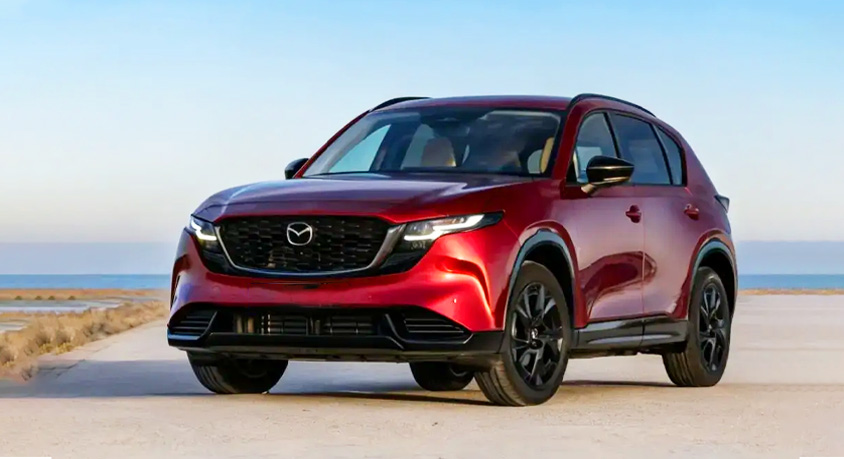
The chassis dynamics reward those who understand that handling matters more than horsepower. Mazda's vehicle dynamics engineers, led by Dave Coleman, tuned the new CX-5 to preserve the outgoing model's fun-to-drive character while adding compliance for improved ride quality. On the twisty mountain roads outside San Diego, the CX-5 exhibits the same athleticism that has defined this nameplate for a decade—neutral balance, responsive steering, and a willingness to rotate slightly when you lift off the throttle mid-corner. The steering, electrically assisted, weights up naturally and delivers feedback that, while artificially generated, proves consistently accurate. The standard all-wheel drive, unique in this segment, biases power rearward under acceleration to enhance cornering feel rather than simply providing snow traction. It's not a Miata, but it's closer to one than anything else in the compact SUV class.
The interior transformation addresses the complaints that kept the CX-5 from true greatness. The rear seat, previously a punishment for anyone over six feet, now offers genuine accommodation thanks to a 4.5-inch wheelbase stretch and larger door openings that simplify child seat loading. Jalopnik's 6-foot-8 reviewer reported fitting comfortably behind his own driving position, a testament to how thoroughly Mazda addressed the space issue. The cargo area expands to 33.7 cubic feet, still trailing class leaders but now genuinely useful for family duty. The 40/20/40 split rear seat allows carrying skis or lumber while retaining two outboard passengers, a thoughtful touch that reveals Mazda's attention to real-world use cases.
The technology story represents the most dramatic departure from Mazda tradition. Gone is the rotary infotainment controller that enthusiasts cherished and casual users found confusing. In its place sits a 12.9-inch touchscreen on most trims, expanding to 15.6 inches on Premium Plus models, running Google Built-In software with crisp graphics and instant responses. MotorTrend calls it "one of the best systems we've seen from a so-called legacy automaker," praise that acknowledges how far Mazda has come. The interface places climate controls permanently at the bottom of the screen, and natural language voice recognition handles many functions through Google's Gemini AI. But the elimination of physical controls extends too far: there is no volume knob, no tuning knob, no way to instantly silence the stereo without navigating menus or using steering wheel buttons. MotorTrend's reviewer calls this "a safety issue," and he's right.
The daily compromises extend beyond the missing knob. The interior width remains tight at 73.2 inches, more than two inches narrower than the CX-50, which means front passengers sit closer together than in competitors. The center console, now devoid of the rotary controller, features cheap-looking glossy plastic that contrasts awkwardly with the otherwise premium materials. The rear seat, while spacious, still lacks the limousine-like legroom of the Honda CR-V or Volkswagen Tiguan. The fuel economy, rated at 24 mpg city and 30 mpg highway, trails hybrid competitors by a significant margin. And the base price has climbed to $31,485, positioning the CX-5 above the Kia Sportage and Hyundai Tucson while remaining slightly below the Toyota RAV4 and Honda CR-V.
The safety equipment arrives comprehensively, as expected from a brand prioritizing family appeal. Every CX-5 includes adaptive cruise control, lane-keeping assist, blind-spot monitoring, rear cross-traffic alert with automatic braking, and forward collision warning with pedestrian detection. The Premium Plus trim adds Cruising & Traffic Support with lane-change assist, which executes automated lane changes when you tap the turn signal, and a 360-degree camera system with excellent resolution. The Insurance Institute for Highway Safety has awarded the new CX-5 top scores across all crash tests, maintaining Mazda's reputation for protecting occupants.
Disclaimer: Mention of any brand or trademark is for identification purposes only and does not indicate any partnership or endorsement.
