

The obituaries were already written. With Chevrolet killing the Malibu and Ford having abandoned sedans years ago, the mid-size segment looked like a museum exhibit—interesting artifacts that nobody actually buys anymore. Nissan itself seemed ready to pull the plug, signaling that 2025 would be the Altima's final year. Then something unexpected happened: the company reversed course, and the 2026 Altima arrived not with a farewell tour but with a streamlined lineup and a starting price that undercuts everything with a trunk. In an era when the average new car payment has crossed $700 and a base Toyota Camry now starts above $28,000, this Nissan has become the last affordable sedan standing. We spent a week with the 2026 model, commuting through suburban sprawl and highway traffic, to understand whether this budget hero still delivers value or simply reminds us why the segment is dying.
Let's start with the news that matters to anyone shopping on a budget: the Altima still starts under $30,000. The 2026 lineup has been simplified to just two trims—SV and SR—with front-wheel drive SV models beginning at $27,580 before destination. Add the $1,245 delivery fee, and you're looking at approximately $28,825 to get into a brand-new sedan with 17-inch alloy wheels, keyless entry, remote start, and Nissan's Safety Shield 360 suite. That's real money, but in a world where the average transaction price for a new vehicle hovers near $48,000, the Altima represents something genuinely rare: a new car that doesn't require a second mortgage.
The all-wheel drive question deserves attention because it's the feature that keeps the Altima relevant in northern states. For 2026, Nissan continues offering AWD on both SV and SR trims at a $1,400 premium, making this the most affordable way to get year-round traction in a sedan. The system routes power to the rear wheels when front slip is detected, and in our testing on wet pavement, it provided the kind of planted confidence that front-drive competitors cannot match. The trade-off appears in the powertrain numbers: AWD models produce 182 horsepower versus the front-drive's 188, and fuel economy drops from 27/39 mpg to 25/34. For Upper Midwest buyers who remember last winter's pothole season, that compromise is worth making.
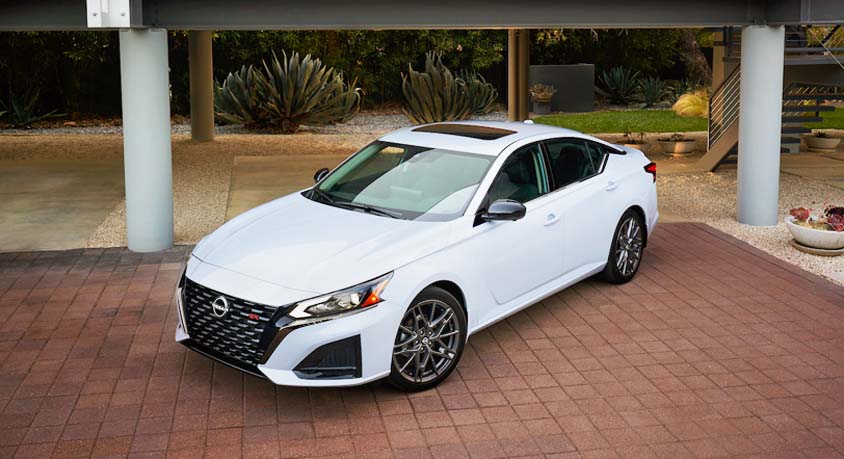
The Zero Gravity seats remain the Altima's secret weapon, and they explain why Nissan has survived while others retreated. Originally inspired by NASA research into the neutral body posture astronauts assume in weightlessness, these seats distribute pressure evenly across the occupant's frame, reducing fatigue on long commutes. On a three-hour round trip through stop-and-go traffic, my back emerged without the usual ache that accumulates in lesser chairs. The SR trim adds sport seats with contrast stitching, but the fundamental geometry remains identical—supportive without being hard, cushioned without allowing sinking. For the driver who spends two hours daily battling congestion, this feature alone justifies the purchase price.
The technology updates for 2026 address the complaints that accumulated over previous years. The SR trim now includes a standard 12.3-inch touchscreen with wireless Apple CarPlay and Android Auto, along with a wireless charging pad that includes a cooling fan. The interface responds crisply, and the menu logic keeps climate controls accessible rather than burying them in submenus. The SV makes do with an 8-inch screen, but wireless connectivity remains standard, and the physical knobs for volume and tuning survive—a small mercy in an era of touch-only interfaces. The optional Bose nine-speaker audio system, available in the SR Premium package, delivers clarity that distracts from the engine noise at highway speeds.
The powertrain reveals the compromises that keep the price low. Every Altima uses a 2.5-liter four-cylinder paired with Nissan's Xtronic continuously variable transmission, producing 188 horsepower in front-drive configuration. The 0-60 mph sprint requires approximately 7.5 seconds, adequate for merging but never exciting. The CVT, historically a source of reliability concerns, has been refined over years of production, and recent data suggests durability has improved significantly. At steady highway speeds, the transmission holds the engine at low rpm, contributing to the 39 mpg highway figure that genuinely delivers on its promise. In mixed driving, our test car averaged 32 mpg—respectable if not class-leading.
The safety story reinforces the family appeal. Nissan Safety Shield 360 comes standard across all trims, including forward collision warning with pedestrian detection, automatic emergency braking, blind-spot monitoring, rear cross-traffic alert with automatic braking, lane departure warning, and automatic high beams. The Insurance Institute for Highway Safety has not yet rated the 2026 model, but the structural design carries over from previous generations that earned top marks. Adaptive cruise control and lane departure steering assist are available on both trims, while the SR Premium package adds a 360-degree camera system that makes parking this 193-inch sedan surprisingly manageable.
The daily annoyances accumulate despite the value proposition. The interior plastics, while improved, still include hard surfaces on the lower doors and dashboard that remind you of the price point. The rear seat, with 35.2 inches of legroom, accommodates adults but doesn't encourage long journeys for those behind the driver. The trunk measures 15.4 cubic feet—adequate but unremarkable. The CVT, while reliable, produces the rubber-band effect that driving enthusiasts despise, with engine rpm rising and holding while speed builds gradually. The steering, electrically assisted, provides minimal feedback and weights artificially. None of these are deal-breakers, but they explain why the Altima never makes enthusiast wish lists.
The competitive landscape clarifies the Altima's positioning. The Toyota Camry, fully redesigned for 2025, starts above $28,000 and now comes exclusively as a hybrid—more efficient but more expensive and lacking the Altima's AWD option. The Honda Accord, similarly priced, offers hybrid efficiency and a more premium interior but starts thousands higher. The Subaru Legacy provides standard AWD but costs more and sells in smaller numbers. The Nissan's advantage lies in its entry price and the availability of all-wheel drive at the lowest cost in the segment. For buyers who need winter traction and a budget that cannot stretch to $35,000, the Altima is the only game in town.
Disclaimer: Mention of any brand or trademark is for identification purposes only and does not indicate any partnership or endorsement.
