

Last Saturday, I watched my neighbor struggle for fifteen minutes to parallel park his shiny, chrome-slathered Ford F-150 Limited in front of a coffee shop, nearly taking out a mailbox and a stray Labrador in the process. It was a pathetic display of "too much truck" for a man whose heaviest load is usually a bag of premium organic kale. I was sitting right behind him in the 2025 Ford Maverick, and while he was sweating through his polo shirt trying to manage a vehicle with the turning radius of an aircraft carrier, I slipped into a tiny spot with the ease of a Honda Civic. We’ve been lied to for a decade by marketing departments claiming we need three tons of steel and a V8 to live an American life, but this little unibody disruptor is here to call their bluff.
The interior of the Maverick is where Ford finally stopped pretending that "luxury" means gluing fake wood to every flat surface. Instead, they used interesting textures and plastics that actually look like they were designed by someone who understands industrial aesthetics rather than a bored accountant. That said, I need to talk about the rotary gear shifter. I hate it. It feels like the volume knob on a cheap 1990s boombox, lacking any of the mechanical satisfaction you get from a proper floor-mounted lever. When you’re backing up to a trailer, you want to feel a distinct, heavy "clunk" as you hit Reverse, not a vague electronic click that feels like you’re selecting a cycle on a washing machine.
Under the hood of the hybrid model, you’ve got a 2.5-liter Atkinson-cycle four-cylinder paired with an electric motor that works with the seamlessness of a veteran jazz duo. It doesn't have the chest-thumping bravado of a Silverado, but it has something much better for your daily life: instant torque. When you pull away from a green light, there’s no waiting for a turbo to spool or a transmission to downshift three times. It just goes. The transition between electric and gas power is so smooth you’ll barely notice it, unlike the clunky, shuddering stop-start systems found in the Toyota Tacoma that feel like the engine is having a mild seizure every time you stop at a light.
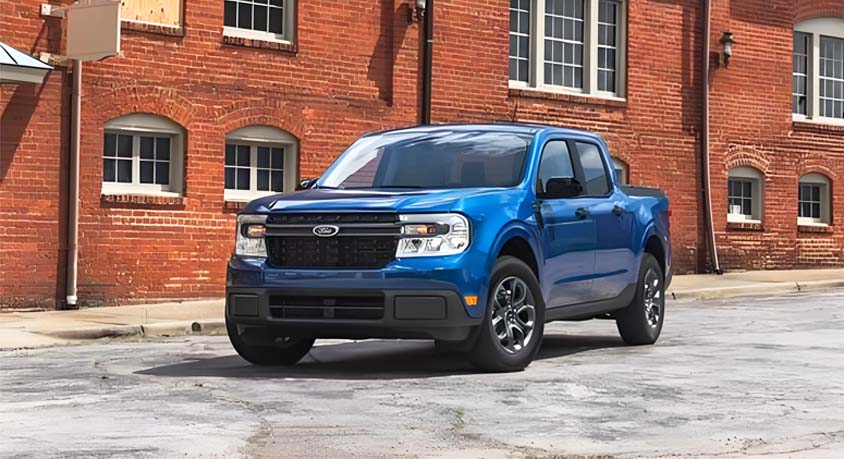
Steering this thing is a revelation if you’re used to the vague, "vessel-at-sea" feeling of a traditional body-on-frame pickup. The steering rack feels direct and surprisingly communicative, more like a well-sorted crossover than a utility vehicle. The rim of the steering wheel has a grainy, rugged texture—it feels like gripping a high-end power tool rather than a delicate leather glove. This tactile feedback gives you the confidence to actually carry speed through a corner, something that would result in a terrifying amount of body roll and tire squeal in a Frontier or a Ranger.
Let’s talk about the "FlexBed," which is the Maverick’s secret weapon for anyone who actually does their own home maintenance. Last month, I went to Home Depot to pick up six sheets of 4x8 plywood and a dozen 2x4s for a backyard shed project. In a mid-sized truck like the Chevy Colorado, you’re dealing with a high lift-over height that punishes your lower back. With the Maverick, the bed sits low enough that loading heavy materials feels like sliding a tray into an oven. You drop the tailgate to the halfway position, and those plywood sheets sit perfectly flat. It’s a brilliant bit of "blue-collar" engineering that proves you don't need a six-foot-high tailgate to get real work done.
The fuel economy is where this truck absolutely humiliates the competition. I’m averaging nearly 40 mpg in mixed city driving. Think about that for a second. You’re getting the utility of a truck with the fuel bills of a Corolla. My friend’s Jeep Gladiator barely breaks 18 mpg on a good day, and he spends half his life at the Exxon station complaining about the price of mid-grade. The Maverick is the first vehicle in a long time that addresses the anxiety of the American middle class: the desire to be useful without being financially bled dry by a fuel pump.
However, don't expect the Maverick to be a silent sanctuary. The sound insulation is, frankly, a bit thin. When you’re cruising at 75 mph on the interstate, the wind noise around the A-pillars sounds like a distant hurricane, and the tire roar from the factory Continentals is prominent enough that you’ll have to crank the radio. It lacks the vault-like silence of a Honda Ridgeline, which remains the king of refined "soft" trucks. But then again, the Ridgeline starts at ten thousand dollars more, and for that kind of cash, I can buy a very nice pair of noise-canceling headphones and still have money left for a year’s worth of ammo and beer.
The back seat is another area where reality hits. If you’re planning on taking three grown men on a four-hour road trip to a fishing hole, the guys in the back are going to hate you by the second hour. Legroom is tight, and the seatback is more vertical than a church pew. But for throwing a couple of kids in the back for a trip to soccer practice or hauling a week’s worth of groceries, it’s more than adequate. It’s a tool, not a limousine, and as long as you treat it like one, you won’t be disappointed.
Ford has hit a home run here by simply listening to what people actually do with their vehicles. They realized that 90% of truck owners don't tow 10,000 pounds or crawl over boulders; they haul mulch, move furniture, and commute to work. The Maverick is the honest truck for an dishonest age. It’s not trying to make you look like a cowboy; it’s just trying to help you get your Saturday chores done so you can get back to the things that actually matter. It’s the most rational vehicle on sale in America today, and it makes almost every other pickup look like an insecure cry for help.
Disclaimer: Mention of any brand or trademark is for identification purposes only and does not indicate any partnership or endorsement.
