

I was at Willow Springs, strapped into the driver’s seat of the Ioniq 5 N, when a guy in a BMW M3 Competition pulled alongside in the paddock and asked, “Does it make any noise?” He said it the way you’d ask if a toaster makes noise. I told him to wait. Then I punched it out of the pits, let the fake eight-speed transmission “shift” at 7,000 rpm, and listened to the synthesized exhaust crackle through the rear speakers like a four-cylinder turbo having a tantrum. His jaw dropped. Not because the sound is good—it’s not, really—but because Hyundai actually did it. They built an electric crossover that pretends to be a combustion car. It’s ridiculous. It’s unnecessary. It’s the most fun I’ve had in an EV since the Porsche Taycan Turbo S, and that car costs twice as much.
The fake shifting is going to piss off the purists, and I get it. The Ioniq 5 N uses motor torque control to simulate an eight-speed dual-clutch transmission. When you “upshift,” the power cuts for a fraction of a second, the seat kicks you in the back, and the speakers fire off a synthesized exhaust bark. It’s a lie. A beautiful, stupid, grin-inducing lie. When I was merging onto the highway, I found myself downshifting just to hear the fake rev-match blip, like a kid making engine noises with his mouth. The Tesla Model Y Performance is faster in a straight line and doesn’t bother with this theater. But the Tesla feels cold. Clinical. The Ioniq 5 N feels like a car that wants you to play with it. Hyundai understood something that Elon Musk never will: sometimes, people buy cars for the show, not just the go.
The chassis tuning is where this thing genuinely shocked me. Under the floor is an 84 kWh battery pack, and the car weighs 4,800 pounds. That’s heavy. But Hyundai fitted adaptive dampers, rear-wheel steering, and a set of electronically controlled limited-slip differentials that make this thing handle like it lost 1,000 pounds in the wash. I took it through a set of canyon switchbacks where a Ford Mustang Mach-E GT would have plowed into understeer and given up. The Ioniq 5 N rotated. The rear end stepped out just enough to tuck the nose into the corner, and the steering—properly weighted, communicative—let me place the front tires within inches of the edge. It’s not a Porsche Cayman. But it’s closer than anything with this much mass has any right to be.
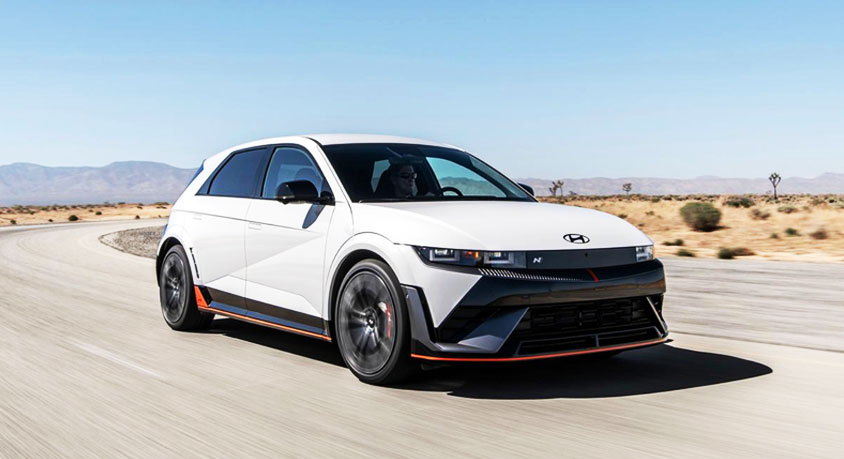
The steering feel deserves its own rant because Hyundai did something here that BMW forgot how to do. The rack is mounted to the front subframe with extra stiffness, and you feel it. When you’re carving through a corner, the wheel loads up progressively, giving you feedback about what the front tires are doing. It’s not hydraulic-level communication, but it’s better than the M2’s numb, video-game steering. The rear-wheel steering helps too. At low speeds, the rear wheels turn opposite the fronts, which makes parking this thing in a tight garage feel like driving a Mini Cooper. I squeezed it into a spot at my local Home Depot where a standard Ioniq 5 would have needed three attempts. The trade-off is a weird sensation at highway speeds where the rear wheels steer with the fronts, making lane changes feel slightly synthetic. You get used to it. But it’s there.
The interior is where Hyundai reminds you that this is still a $67,000 Hyundai, not a Porsche. The materials are fine. The seats are aggressively bolstered, which is great for track days but brutal for picking up your kid from school. I drove my daughter to her soccer practice, and she complained that the seat bolsters were digging into her thighs. She’s nine. That’s a problem. The fake suede on the steering wheel feels good in your palms until it starts matting down after a week of use. The infotainment screen is crisp, but the interface is busy. You have to dig through menus to change drive modes, which means you’re either using the bright red “N” button on the steering wheel or you’re distracted while driving. A Tesla has a simpler interface. A Ford Mustang Mach-E has physical buttons for basic functions. Hyundai split the difference and ended up with neither simplicity nor tactility.
The performance numbers are real, and they’re brutal. 641 horsepower with the “N Grin Boost” engaged, which gives you ten seconds of overboost. Zero to sixty in 3.3 seconds. That’s quicker than a BMW M3 Competition. Quicker than a Porsche 718 Cayman GTS. But here’s the thing: you stop caring about the numbers after the third launch. What matters is how the car delivers that power. In Normal mode, it drives like a standard Ioniq 5—quiet, smooth, efficient. I drove it from Los Angeles to San Diego on a single charge, cruising at 75 mph, and the range estimator was actually honest. When I got off the highway and switched to N mode, the car transformed. The suspension stiffened, the steering weighted up, and the fake engine noise filled the cabin like a microwave heating up a can of soup. It’s artificial. But it’s also a riot.
The sound is the thing people will debate for years. Hyundai calls it “N Active Sound +.” There are three settings: Ignition, which mimics a 2.0-liter turbo four; Evolution, which sounds like a twin-turbo V6; and Supersonic, which is just science fiction noise. I left it on Ignition most of the time because the fake pops and crackles on downshifts made me laugh every single time. My neighbor, the guy with the leased Model Y, heard me pull in one night and walked over to ask what exhaust I had installed. When I told him it was coming out of the speakers, he looked at me like I’d just admitted to enjoying pineapple on pizza. I don’t care. It’s fun. And in a world where EVs are increasingly identical, fun counts for something.
The charging speed is competitive but not class-leading. Hyundai claims 10 to 80 percent in 18 minutes on a 350 kW charger. I saw 230 kW peak at an Electrify America station, which is good. But the charging curve drops off faster than a Kia EV6’s, which uses the same platform. Hyundai tuned the battery management for track performance, not road trip speed. If you’re the kind of person who drives from LA to Vegas every weekend, the Tesla Model Y charges faster on the Supercharger network and has more mature infrastructure. If you’re the kind of person who cares more about canyon roads than charging stops, the Ioniq 5 N makes the trade-off worthwhile.
I parked the Ioniq 5 N next to a Volkswagen Golf R at a cars and coffee event, and a guy in his twenties walked up and asked which one I’d buy. I thought about it for a minute. The Golf R is lighter, has a real manual transmission, and makes genuine engine noises. It’s also slower, less practical, and feels like a car from 2015. The Ioniq 5 N is heavier, weirder, and full of artificial nonsense. But it’s also the first EV that made me forget I was driving an EV. Hyundai built a performance car that happens to run on electricity, not an electric car that happens to be fast. That distinction matters. The purists will complain about the fake shifting. The pragmatists will complain about the price. The people who actually drive this thing will just smile. And sometimes, that’s the only spec sheet that matters.
Disclaimer: Mention of any brand or trademark is for identification purposes only and does not indicate any partnership or endorsement.
